
Truss Bridge Project — Complete Engineering Design Guide, Construction Methods & Real-World Applications
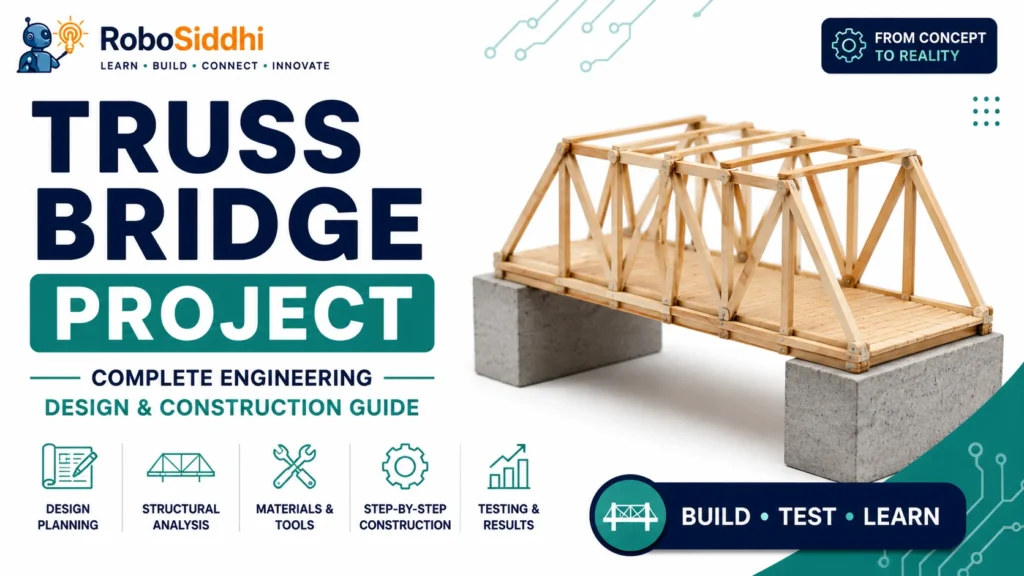
Build a Real Bridge Using Engineering Principles
A truss bridge is one of the most efficient bridge designs in civil engineering. Truss bridges use triangular structures to distribute weight and create strong, lightweight bridges that can span long distances with minimal material.
This comprehensive guide teaches you everything about truss bridge engineering — from design principles to actual construction. Whether you are a student, engineer, or maker, you will learn how professional bridges are designed and built.
What is a Truss Bridge? Why Are They So Special?
A truss bridge is a bridge that uses triangular frameworks (trusses) to support the bridge deck.
Why Triangles?
Triangles are the strongest geometric shape. Unlike rectangles or other shapes, triangles cannot be deformed without changing the length of one of their sides. This makes triangles ideal for load-bearing structures.
When weight is applied to a truss bridge, the force is distributed throughout the triangular framework, spreading the load efficiently across multiple support points.
Advantages of Truss Bridges:
- Strong — Triangular design creates maximum strength
- Lightweight — Uses less material than solid bridges
- Cost-Effective — Efficient use of materials reduces cost
- Flexible Design — Can be modified for different spans and loads
- Proven Track Record — Used for over 200 years in bridge engineering
Famous Truss Bridges:
- Forth Bridge (Scotland) — One of the longest cantilever bridges in the world
- Hell Gate Bridge (New York) — Steel arch bridge with truss structure
- Sydney Harbour Bridge (Australia) — Iconic steel arch-truss hybrid design
- Golden Gate Bridge (San Francisco) — Suspension bridge with truss elements
Types of Truss Bridge Designs
Different truss bridge designs serve different purposes. Here are the main types:
Warren Truss
Design: Alternating triangular and inverted triangular pattern
Advantages:
- Excellent strength-to-weight ratio
- Uses fewer internal members
- Efficient load distribution
Best For: Medium-span bridges, railway bridges
Real Example: Used in many modern railway bridges
Pratt Truss
Design: Diagonal members slope inward from top to bottom
Advantages:
- Simple, economical design
- Easy to manufacture
- Good for longer spans
Best For: Long-span bridges, highway bridges
Real Example: Historically used for many railroad bridges in North America
Howe Truss
Design: Diagonal members slope outward from top to bottom
Advantages:
- Strong compression strength
- Good for heavy loads
- Used in wooden bridge construction
Best For: Heavy load bridges, older designs
Real Example: Common in wooden covered bridges
King Post Truss
Design: Single central vertical post with diagonal members
Advantages:
- Simplest design
- Good for short spans
- Easy to construct
Best For: Small spans, pedestrian bridges, educational models
Best For Your Project: This is the easiest type for beginners to build
Materials Needed for a Truss Bridge Project
For a Basic Model Bridge (Beginner):
Structural Materials:
- Wooden dowels or struts (bamboo sticks work well)
- Balsa wood strips for main beams
- String or twine for connections
- Wood glue or hot glue gun
- Nails or screws (small)
Testing Materials:
- Weights (books, sand, weights)
- Ruler for measurements
- Weight scale for load testing
Tools:
- Saw (hand saw or power saw)
- Drill with bits
- Sandpaper
- Pencil and ruler
- Clamps for holding during assembly
For an Advanced Model Bridge (Intermediate):
Additional Materials:
- Steel rods or aluminum tubing
- Metal connectors and joints
- Welding equipment (for steel bridges)
- Paint for protection and visibility
Advanced Testing:
- Load sensor for precise measurements
- Video recording for analysis
- Data collection equipment
For a Full-Scale Educational Lab Setup:
RoboSiddhi’s STEM Lab includes all materials and tools needed for bridge engineering projects:
Explore STEM Lab Setup — RoboSiddhi
Complete STEM labs include structural materials, testing equipment, and curriculum for bridge projects.
Step-by-Step Guide to Building a Basic Truss Bridge
Phase 1: Design and Planning
Step 1 — Understand Your Design
Before building, draw your bridge design on paper:
- Decide which truss type you will use (King Post recommended for beginners)
- Determine bridge length, height, and width
- Calculate number of trusses needed
- Sketch member lengths and angles
Step 2 — Create a Scale Model
First build a small-scale model (1/10th or 1/20th actual size):
- Tests your design before committing materials
- Identifies design flaws early
- Much cheaper and faster
Step 3 — Calculate Load Capacity
Using the triangular structure:
- Each triangle distributes weight to its corners
- Multiple trusses share the total load
- Calculate expected breaking point
Phase 2: Material Preparation
Step 4 — Cut All Members to Length
Using your design drawings:
- Measure and mark all dowels and beams
- Cut each piece to exact length
- Sand all surfaces smooth
- Remove sharp edges for safety
Step 5 — Pre-Drill Holes (Optional)
For stronger joints:
- Pre-drill holes for fasteners
- Prevents splitting wood
- Creates precise alignment
Phase 3: Assembly
Step 6 — Build Individual Trusses
Assemble each triangular truss on a flat surface:
- Lay out three members in triangle shape
- Apply wood glue to joints
- Clamp until dry (2-4 hours)
- Reinforce with nails or small screws at joints
- Test for square before drying completely
Step 7 — Connect Trusses Together
Join individual trusses to create the bridge:
- Use horizontal members to space trusses
- Ensure all trusses are parallel
- Create level surface for bridge deck
Step 8 — Add Bridge Deck
Create the surface that carries the load:
- Use plywood or wooden boards
- Attach to the top of the truss structure
- Ensure smooth, level surface
- Sand any rough edges
Step 9 — Add Support Bearings
At each end, install bearing supports:
- Allows the bridge to rest securely
- Permits slight movement
- Distributes load to foundations
Phase 4: Testing
Step 10 — Conduct Load Testing
Test your bridge before declaring it complete:
- Start with light weight (1-2 kg)
- Gradually increase load
- Watch for deflection (bending)
- Note any unusual sounds or movement
- Continue until bridge fails or reaches maximum safe load
Step 11 — Record Results
Document all test data:
- Maximum load supported
- Amount of deflection at maximum load
- Any areas of failure
- Comparison to design predictions
Step 12 — Calculate Efficiency
Bridge efficiency ratio:
- Efficiency = Maximum Load Supported / Weight of Bridge Structure
- Higher ratio = more efficient design
Real-World Bridge Engineering Principles
The same principles you use in your model apply to real bridges:
Load Paths
In a truss bridge, loads follow specific paths:
- Weight on deck → transferred to top chord → distributed through diagonals → collected by bottom chord → transmitted to supports
Compression and Tension
Different members experience different forces:
- Compression members — Being squeezed (typically top chord)
- Tension members — Being pulled (typically bottom chord)
- Both types — Some members experience both depending on load location
Factor of Safety
Real bridges are built with safety margins:
- A bridge designed for 100-ton load might be built to handle 300+ tons
- Safety factor of 3 is typical
- Accounts for unexpected loads, age, and wear
Environmental Factors
Real bridges must account for:
- Wind loads
- Earthquakes
- Temperature changes (expansion and contraction)
- Water flow (for water crossings)
- Corrosion and aging
Truss Bridge Project Ideas by Difficulty Level
Beginner Projects (Class 4-6)
Simple King Post Truss Bridge
- Span: 50-100 cm
- Materials: Wooden dowels, glue
- Load: 2-5 kg
- Time: 4-8 hours
- Learning Focus: Basic truss structure, joint connections
Suspended Cable Bridge
- Span: 30-50 cm
- Materials: Dowels, string, weights
- Load: 1-2 kg
- Time: 3-5 hours
- Learning Focus: Cable tension, support systems
Intermediate Projects (Class 7-8)
Warren Truss Bridge
- Span: 100-150 cm
- Materials: Dowels, metal connectors, glue
- Load: 10-20 kg
- Time: 12-16 hours
- Learning Focus: Complex geometry, efficient design
Pratt Truss Bridge
- Span: 80-120 cm
- Materials: Balsa wood, metal joints, fasteners
- Load: 8-15 kg
- Time: 10-14 hours
- Learning Focus: Diagonal member efficiency, load distribution
Advanced Projects (Class 9-10)
Full-Scale Bridge Model
- Span: 2-3 meters
- Materials: Steel, aluminum, welded joints
- Load: 50-100 kg
- Time: 30-40 hours
- Learning Focus: Real engineering, precise calculations, safety factors
Cantilever Bridge
- Span: 1-2 meters
- Materials: Steel, engineering connectors
- Load: 20-50 kg
- Time: 20-30 hours
- Learning Focus: Moment balance, overhanging structures
Suspension Bridge with Truss Towers
- Span: 1.5-2.5 meters
- Materials: Steel cables, steel frame, wood deck
- Load: 30-60 kg
- Time: 35-50 hours
- Learning Focus: Cable tension, suspended systems
Learn Bridge Engineering — Complete Online Course
RoboSiddhi offers comprehensive STEM and Engineering courses that include bridge project design:
STEM Engineering Curriculum
The STEM Lab Setup includes complete bridge engineering curriculum for different class levels:
Explore STEM Lab Curriculum — RoboSiddhi
What You Will Learn:
- Bridge types and structural principles
- Load calculation and stress analysis
- Materials science for bridges
- CAD design basics
- Real-world engineering projects
Online Engineering Courses
For students wanting detailed instruction:
Access RoboSiddhi Online Courses — Complete Learning Platform
Courses cover:
- Structural engineering basics
- Bridge design principles
- Project management
- Materials and construction
Real-World Applications of Truss Bridge Design
Understanding truss bridges helps you understand many structures:
Civil Engineering
- Highway bridges
- Railway bridges
- Pedestrian bridges
- Water crossing bridges
Mechanical Engineering
- Crane structures
- Aircraft wings (use truss principles)
- Tower construction
- Scaffolding systems
Architecture
- Roof trusses in buildings
- Dome structures
- Large-span gymnasium designs
Aerospace
- Aircraft fuselage design
- Space structure frameworks
- Antenna towers
Common Mistakes in Bridge Building (And How to Avoid Them)
Mistake 1: Unequal Joint Angles
- Problem: Creates weak points
- Solution: Use a protractor to verify angles during assembly
Mistake 2: Loose Connections
- Problem: Joints slip under load, bridge deflects excessively
- Solution: Use wood glue AND mechanical fasteners (nails/screws)
Mistake 3: Inadequate Testing
- Problem: Don’t discover failures until catastrophic collapse
- Solution: Gradually increase load, monitoring continuously
Mistake 4: Ignoring Deflection
- Problem: Bridge bends too much, becomes unsafe
- Solution: Measure deflection under load; redesign if needed
Mistake 5: Poor Material Choices
- Problem: Wood warps, materials fail prematurely
- Solution: Use seasoned wood, appropriate fasteners for materials
Mistake 6: Skipping Documentation
- Problem: Can’t replicate success, can’t analyze failures
- Solution: Keep detailed notes, photos, measurements
Materials and Equipment Available for Purchase
For your truss bridge project, you will need various materials and tools. RoboSiddhi Shop offers:
Wood and Materials
- Dowels (multiple diameters)
- Balsa wood sheets
- Wood glue, fasteners
- Sandpaper, finishing materials
Tools
- Saws, drills, clamps
- Measurement tools
- Safety equipment
Browse All Materials and Tools — RoboSiddhi Shop
All materials available for school projects, student kits, and individual purchases.
Learn Bridge Building Through Video Tutorials
RoboSiddhi’s YouTube channel features engineering and STEM project tutorials:
Watch Free Engineering Tutorials — RoboSiddhi YouTube Channel
Find videos on:
- Structural engineering basics
- STEM project walkthroughs
- Materials science
- Real-world engineering applications
Frequently Asked Questions About Truss Bridge Projects
Q: What age group is appropriate for this project? A: Basic models (Class 4-6), intermediate designs (Class 7-8), advanced projects (Class 9-10 and beyond).
Q: How long does a bridge project take? A: Beginner projects: 4-8 hours. Intermediate: 12-16 hours. Advanced: 30+ hours.
Q: Can we use different materials than wood? A: Yes. Aluminum, steel, PVC, even plastic can be used. Material choice affects strength, cost, and difficulty.
Q: What load should the bridge support? A: That depends on your design. Start with light loads (2-5 kg), increase based on structure. Real engineering calculations determine safe loads.
Q: How do we test the bridge safely? A: Use sandbags or water containers (controlled weight increase). Never stand on an untested bridge. Have proper supports underneath.
Q: Can this be a school competition project? A: Yes. Many schools and competitions feature bridge engineering challenges. Check local STEM competitions.
Q: Is there a formula to calculate bridge strength? A: Yes, but it requires structural engineering knowledge. Use simplified formulas for school projects. Advanced calculations require engineering software.
Q: What is the most important part of a bridge? A: Joints. The strength of connections determines bridge strength more than individual members.
School Project Submission Guidelines
If you are building this for a school assignment:
Documentation Required:
- Design drawings and specifications
- Material list with costs
- Construction process photos
- Load testing results with data
- Analysis of performance vs. design predictions
- Reflection on challenges and improvements
Presentation Tips:
- Create a poster or presentation showing your design process
- Bring photos or video of construction and testing
- Discuss real-world bridge applications
- Present your data clearly (charts, graphs)
- Be prepared to answer engineering questions
Grading Criteria (Typical):
- Design quality (30%)
- Construction craftsmanship (25%)
- Load capacity achieved (25%)
- Documentation and presentation (20%)
Next Steps — Start Your Bridge Project Today
Option 1: DIY at Home
- Gather materials from RoboSiddhi Shop
- Follow this guide step-by-step
- Document your project
- Share results
Option 2: School STEM Lab
Ask your school to set up a STEM Lab with bridge engineering curriculum:
Learn About STEM Lab Setup — RoboSiddhi
STEM labs provide:
- Complete materials and tools
- Curriculum with bridge projects
- Teacher guidance
- Assessment frameworks
Option 3: Online Learning
Enroll in RoboSiddhi’s engineering courses for detailed instruction:
Browse All Online Courses — RoboSiddhi Learning Platform
Courses include:
- STEM engineering principles
- Bridge design tutorials
- Real-world project guides
Related STEM Projects and Learning
After completing your bridge project, explore related topics:
Complete Skill Lab Setup — All 5 Labs Including STEM
Complementary projects:
- Tower design (Eiffel Tower, leaning towers)
- Beam strength testing
- Cantilever structures
- Suspension systems
- Structural failure analysis
Build Your Bridge, Learn Engineering, Change the World!
A bridge is more than wood and glue. It is the application of mathematical and scientific principles to solve real problems. Every bridge you design teaches you something about how structures work.
Start building today. Document everything. Learn deeply. Share your success.