
25+ STEM Projects for Elementary Students: Fun Hands-On Activities for Future Innovators
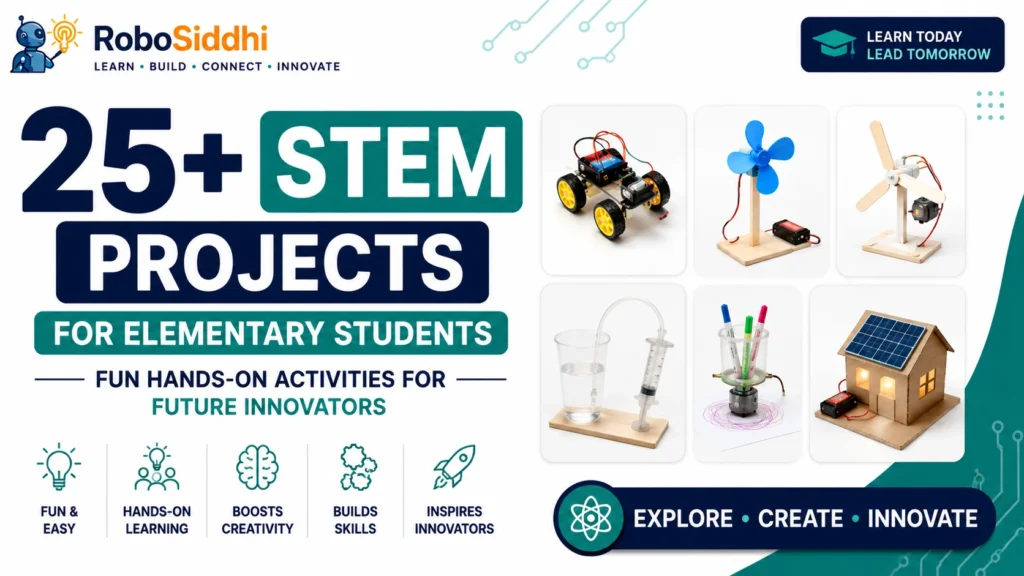
The Ultimate Guide to STEM Projects for Elementary Students
STEM Projects for Elementary Students are one of the most effective ways to introduce young learners to Science, Technology, Engineering, and Mathematics through hands-on experiences. Instead of simply reading concepts from textbooks, students learn by building, experimenting, testing, and solving real-world challenges.
These STEM projects help elementary students develop creativity, critical thinking, teamwork, problem-solving skills, communication abilities, and innovation mindsets from an early age.
Whether you’re a teacher, school administrator, STEM educator, or parent, these STEM Projects for Elementary Students can transform learning into an exciting and engaging experience.
Table of Contents
- Balloon Powered Car
- Straw Rocket Launcher
- Paper Bridge Challenge
- Water Filtration System
- Magnetic Maze
- Solar Oven Model
- Windmill Energy Project
- Floating Boat Challenge
- Earthquake Resistant Tower
- Rubber Band Powered Car
- Simple Circuit with LED
- Hydraulic Lift Model
- Parachute Design Challenge
- Weather Station Project
- Catapult Launcher
- Smart Irrigation Model
- Mini Greenhouse Project
- Pulley System Model
- Hovercraft Experiment
- Marble Run Engineering Challenge
- Water Rocket Project
- Simple Robot Hand
- Balloon Hovercraft
- Solar Powered House
- Bridge Building Competition
Why STEM Projects for Elementary Students Are Important
STEM Projects for Elementary Students encourage active learning through exploration and experimentation. These projects help students:
- Develop scientific thinking
- Improve problem-solving abilities
- Learn engineering concepts
- Build teamwork skills
- Enhance creativity
- Understand technology applications
- Gain confidence in innovation
Hands-on STEM learning also aligns with modern educational approaches such as project-based learning, experiential learning, and NEP 2020 recommendations.
1. Balloon Powered Car
Concepts
- Force
- Motion
- Air Pressure
Materials
- Balloon
- Straw
- Bottle Caps
- Cardboard
Learning Outcome
Students learn how air pressure creates motion and propels objects forward.
2. Straw Rocket Launcher
Concepts
- Aerodynamics
- Flight
- Trajectory
Materials
- Paper
- Straw
- Tape
Learning Outcome
Students explore how rockets move through the air.
3. Paper Bridge Challenge
Concepts
- Structural Engineering
- Load Distribution
Materials
- Paper Sheets
- Books
Learning Outcome
Students design strong structures using limited materials.
4. Water Filtration System
Concepts
- Environmental Science
- Filtration
Materials
- Sand
- Gravel
- Plastic Bottle
Learning Outcome
Students learn basic water purification methods.
5. Magnetic Maze
Concepts
- Magnetism
- Forces
Materials
- Magnet
- Cardboard
- Paper Clips
Learning Outcome
Students understand magnetic attraction and movement.
6. Solar Oven Model
Concepts
- Solar Energy
- Heat Transfer
Materials
- Pizza Box
- Aluminum Foil
- Plastic Wrap
Learning Outcome
Students discover how sunlight can generate heat energy.
7. Windmill Energy Project
Concepts
- Renewable Energy
- Energy Conversion
Materials
- Paper
- Straw
- Pin
Learning Outcome
Students explore how wind can generate power.
8. Floating Boat Challenge
Concepts
- Buoyancy
- Density
Materials
- Aluminum Foil
- Water Container
Learning Outcome
Students investigate why objects float or sink.
9. Earthquake Resistant Tower
Concepts
- Structural Stability
- Engineering Design
Materials
- Popsicle Sticks
- Glue
Learning Outcome
Students learn how engineers design safer structures.
10. Rubber Band Powered Car
Concepts
- Potential Energy
- Motion
Materials
- Rubber Bands
- Cardboard
- Wheels
Learning Outcome
Students understand energy storage and release.
11. Simple Circuit with LED
Concepts
- Electricity
- Conductors
Materials
- Battery
- LED
- Wires
Learning Outcome
Students build their first electrical circuit.
12. Hydraulic Lift Model
Concepts
- Hydraulics
- Fluid Pressure
Materials
- Syringes
- Tubing
- Cardboard
Learning Outcome
Students explore how hydraulic systems work.
13. Parachute Design Challenge
Concepts
- Gravity
- Air Resistance
Materials
- Plastic Bag
- String
Learning Outcome
Students learn how parachutes slow falling objects.
14. Weather Station Project
Concepts
- Weather Science
- Data Collection
Materials
- Thermometer
- Rain Gauge
Learning Outcome
Students collect and analyze weather data.
15. Catapult Launcher
Concepts
- Energy Transfer
- Engineering Design
Materials
- Popsicle Sticks
- Rubber Bands
Learning Outcome
Students understand launch mechanics.
16. Smart Irrigation Model
Concepts
- Agriculture
- Water Conservation
Materials
- Soil
- Water Container
Learning Outcome
Students explore efficient irrigation methods.
17. Mini Greenhouse Project
Concepts
- Plant Growth
- Climate
Materials
- Plastic Bottle
- Seeds
Learning Outcome
Students observe the greenhouse effect.
18. Pulley System Model
Concepts
- Simple Machines
- Mechanical Advantage
Materials
- Rope
- Pulley Wheel
Learning Outcome
Students understand how pulleys reduce effort.
19. Hovercraft Experiment
Concepts
- Friction
- Air Pressure
Materials
- Balloon
- CD Disc
Learning Outcome
Students explore friction reduction.
20. Marble Run Engineering Challenge
Concepts
- Gravity
- Engineering Design
Materials
- Cardboard Tubes
- Marbles
Learning Outcome
Students design pathways using gravity.
21. Water Rocket Project
Concepts
- Thrust
- Aerodynamics
Materials
- Plastic Bottle
- Water
- Air Pump
Learning Outcome
Students understand rocket propulsion principles.
22. Simple Robot Hand
Concepts
- Robotics
- Mechanical Systems
Materials
- Cardboard
- String
- Straws
Learning Outcome
Students build a working robotic hand.
23. Balloon Hovercraft
Concepts
- Friction
- Air Cushion
Materials
- Balloon
- CD Disc
Learning Outcome
Students create a floating vehicle model.
24. Solar Powered House
Concepts
- Renewable Energy
- Sustainability
Materials
- Solar Panel
- Cardboard House
Learning Outcome
Students understand solar energy applications.
25. Bridge Building Competition
Concepts
- Civil Engineering
- Structural Design
Materials
- Popsicle Sticks
- Glue
Learning Outcome
Students test the strength of their designs.
Learn Beyond the Classroom
STEM Projects for Elementary Students become even more effective when combined with structured STEM education programs, project kits, robotics learning, and innovation activities.
STEM & Robotics Online Courses
Students can continue learning through RoboSiddhi’s online learning platform.
Explore Online Courses
Courses Available:
- Arduino Programming
- ESP32 & IoT
- Robotics Engineering
- AI & Machine Learning
- Python Programming
- Drone Technology
- Space Science
Buy STEM & Robotics Kits
Many of these STEM Projects for Elementary Students can be built using RoboSiddhi learning kits.
Buy STEM Kits Online
Popular Kits:
- STEM Learning Kit
- Robotics Starter Kit
- Arduino Kit
- ESP32 Kit
- Electronics Learning Kit
- Sensor Bundle Kit
- Smart Agriculture Kit
Free STEM Video Tutorials
Watch free project tutorials and STEM experiments.
RoboSiddhi YouTube Channel
Related Learning Resources
STEM Lab Setup for Schools
Internal Link:/stem-lab-setup/
Robotics Lab Setup for Schools
Internal Link:/robotics-lab-setup/
AI Lab Setup for Schools
Internal Link:/ai-lab-setup-school/
Skill Lab Setup for Schools
Internal Link:/skill-lab-setup-school/
Space Education Lab
Internal Link:/space-education-lab/
Atal Tinkering Lab Setup
Internal Link:/atal-tinkering-lab-setup/
Teacher Training Programs
Internal Link:/teacher-training/
Frequently Asked Questions
What are STEM Projects for Elementary Students?
STEM Projects for Elementary Students are hands-on learning activities that combine Science, Technology, Engineering, and Mathematics to help students learn through practical experiences.
Why are STEM projects important for elementary students?
They improve creativity, critical thinking, problem-solving skills, teamwork, and innovation abilities while making learning fun and engaging.
What age is suitable for STEM projects?
Most STEM Projects for Elementary Students are suitable for ages 6–12 and can be adapted based on grade level.
Can schools use these projects in STEM Labs?
Yes. These projects are ideal for STEM Labs, Innovation Labs, Robotics Labs, and classroom activities.
Conclusion
STEM Projects for Elementary Students provide the perfect foundation for future learning in Robotics, Artificial Intelligence, Engineering, Coding, Space Science, and Innovation. Through hands-on experiments and project-based learning, students develop essential skills that prepare them for future careers and technological advancements.
Schools that implement STEM Projects for Elementary Students create engaging learning environments where curiosity, creativity, and innovation thrive every day.