
Table of Contents
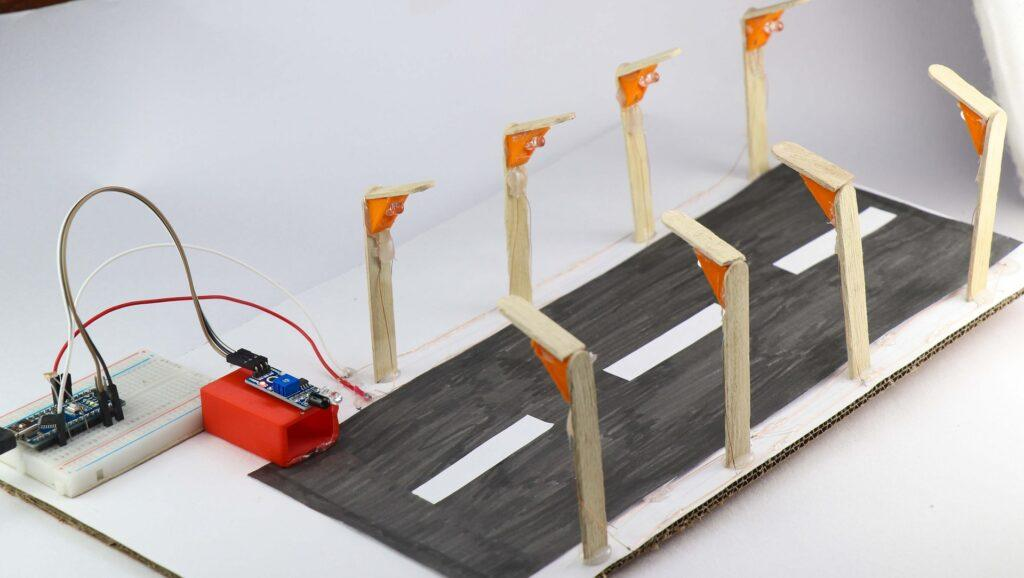
Technology is making our lives smarter every day. One of the best examples of automation that we see around us is the automatic street light system. These lights automatically switch ON during the night and turn OFF during the daytime without requiring any human intervention. In this Grade 9 STEM Activities project, students will learn how to create a Smart Street Light Using Arduino using a Light Dependent Resistor (LDR), an LED, and an Arduino Uno board.
This project is an excellent way to understand automation, sensors, programming, and electronics. Students will explore how a sensor can detect environmental conditions and how a microcontroller can make decisions based on sensor data. The Smart Street Light Using Arduino project combines science, technology, engineering, and mathematics into a single hands-on learning experience.
What is a Smart Street Light Using Arduino?
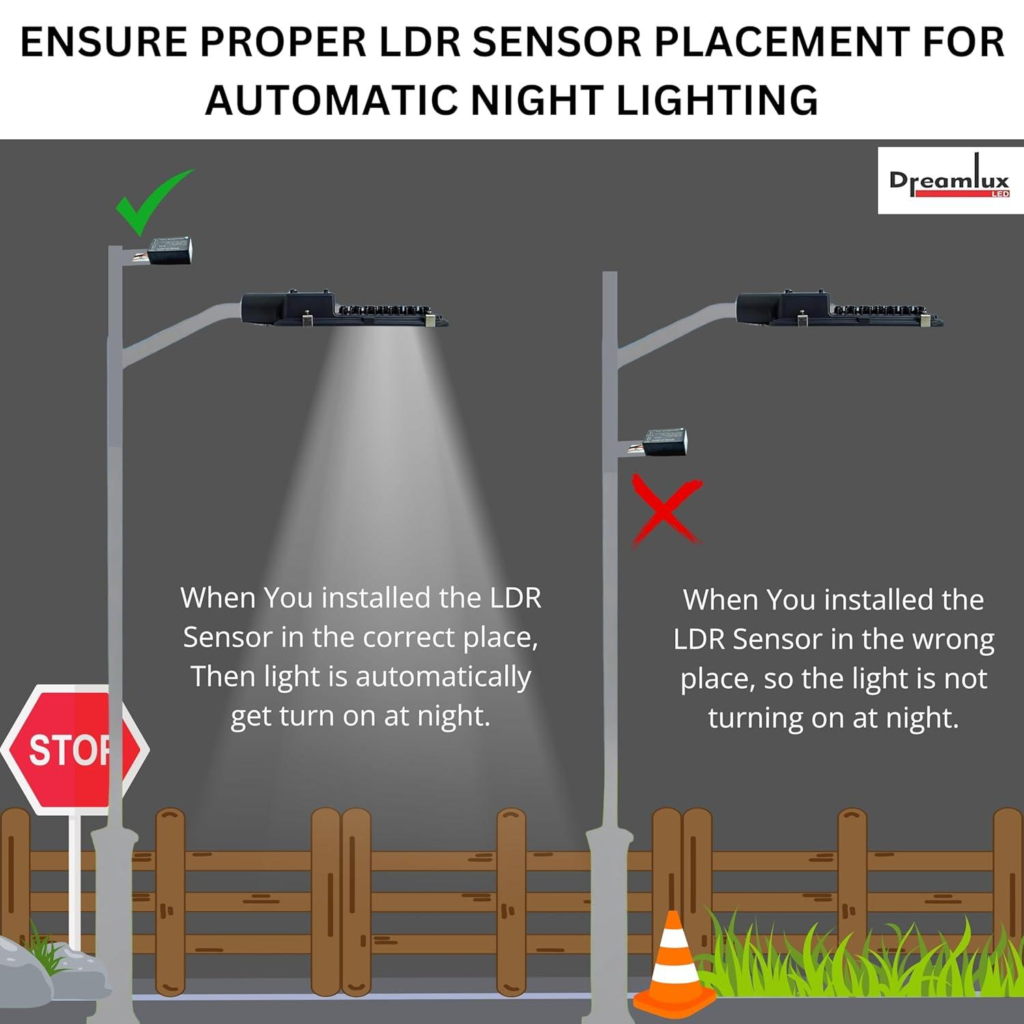
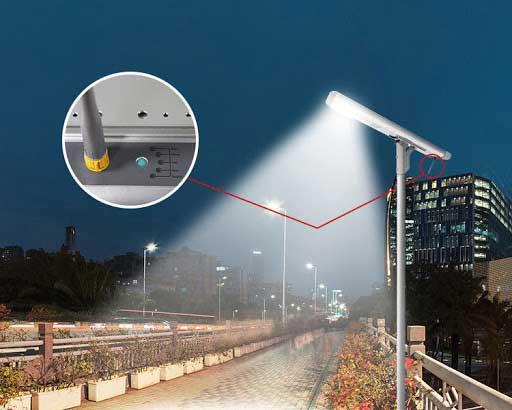
A Smart Street Light Using Arduino is an automatic lighting system that uses an LDR sensor to detect ambient light levels. During the daytime, when sufficient sunlight is available, the LED remains OFF. When the surroundings become dark, the Arduino detects the change in light intensity and automatically turns the LED ON.
This type of system is commonly used in:
- Street lighting systems
- Garden lighting
- Parking areas
- Smart city projects
- Home automation systems
The Smart Street Light Using Arduino project demonstrates how simple sensors and programming can create useful real-world automation solutions.
Components Required
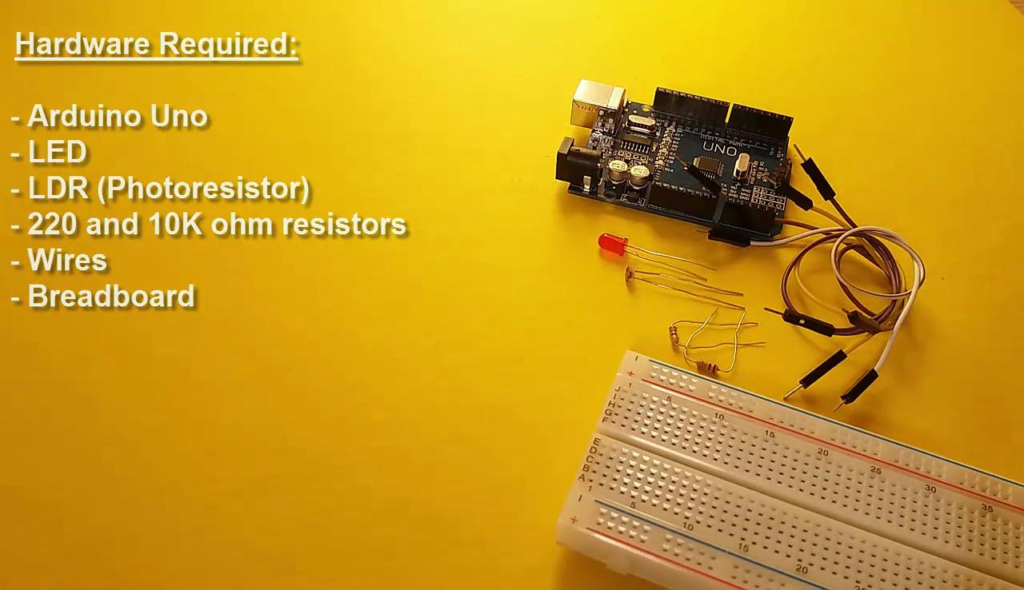
To build the Smart Street Light Using Arduino project, students will need the following components:
- Arduino Uno Board
- LDR (Light Dependent Resistor)
- LED
- 2 Resistors
- Breadboard
- Jumper Wires
- USB Cable
These components are inexpensive and ideal for educational STEM activities.
Understanding the LDR Sensor
An LDR (Light Dependent Resistor) is a sensor whose resistance changes according to the amount of light falling on it.
How an LDR Works
- High light intensity → Low resistance
- Low light intensity → High resistance
The LDR is made from Cadmium Sulfide (CdS), a material that exhibits photoconductivity. When light strikes the sensor, electrons become energized and move more freely, reducing resistance. When darkness increases, resistance rises.
This property makes the LDR perfect for the Smart Street Light Using Arduino project because it can detect day and night conditions automatically.
Circuit Connections
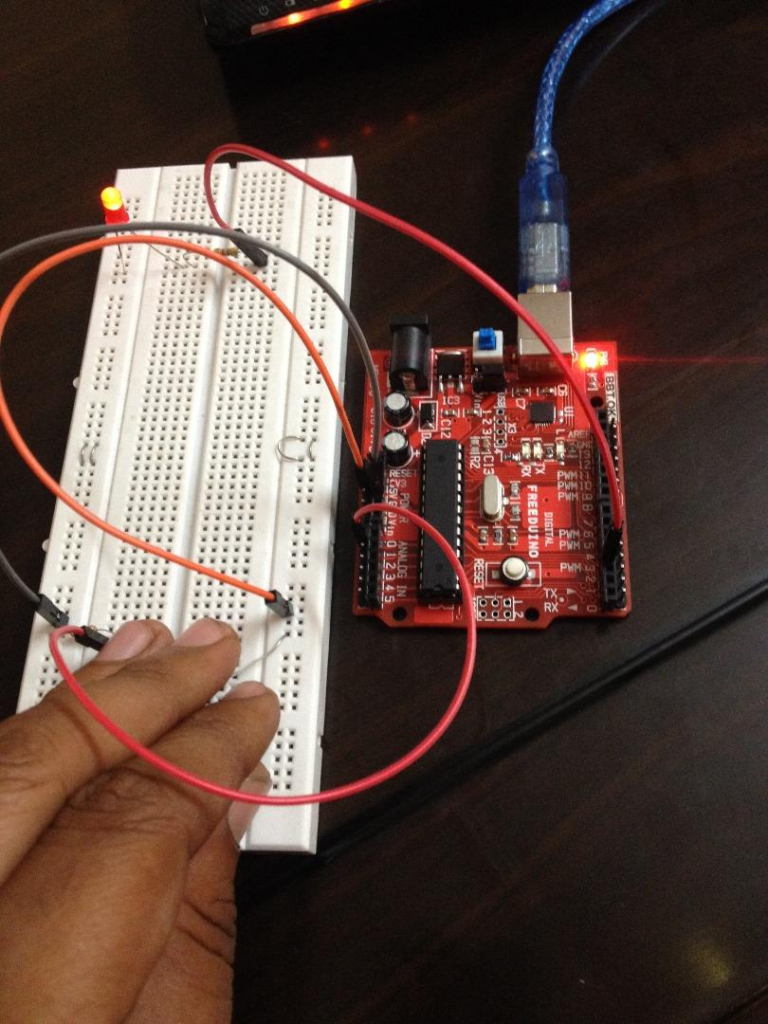
The circuit setup is simple and beginner-friendly.
LED Connections
- Connect the LED positive terminal (anode) to Arduino Digital Pin 2.
- Connect the LED negative terminal (cathode) through a resistor to GND.
LDR Connections
- Connect one terminal of the LDR to 5V.
- Connect the other terminal to Analog Pin A0.
- Connect a resistor from the A0 junction to GND.
This arrangement creates a voltage divider circuit that allows Arduino to read varying voltage levels depending on light intensity.
Working Principle of Smart Street Light Using Arduino
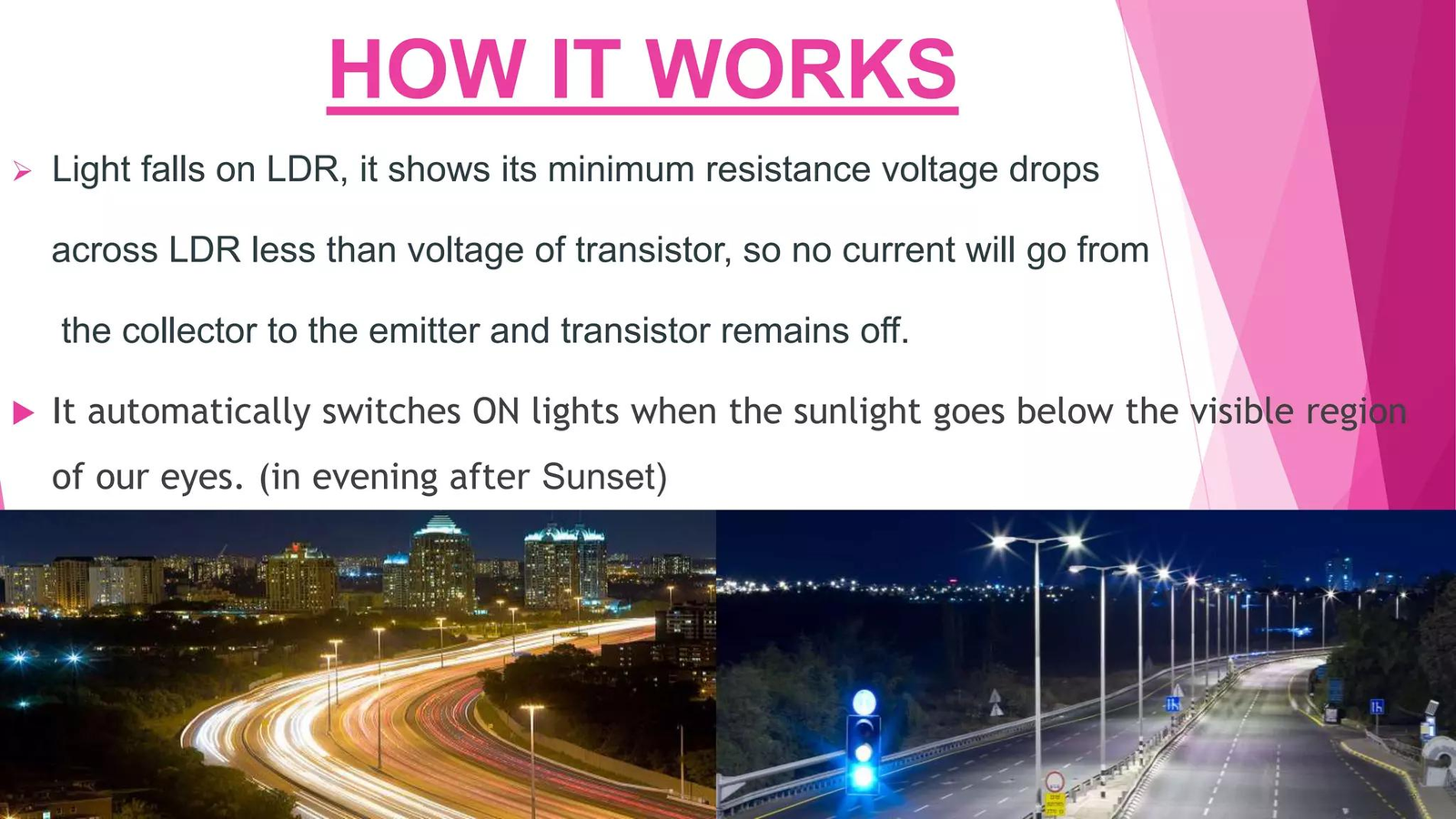
The Smart Street Light Using Arduino operates based on the changing resistance of the LDR sensor.
During Daytime
When bright light falls on the LDR:
- Resistance decreases
- Analog value increases
- Arduino recognizes daylight conditions
- LED remains OFF
During Nighttime
When darkness increases:
- Resistance increases
- Analog value decreases
- Arduino detects low light levels
- LED turns ON automatically
This simple logic forms the basis of many real-world automated lighting systems.
Arduino Programming Logic
The Arduino code consists of three main parts:
1. Variable Declaration
The LDR and LED pins are declared.
2. Setup Function
The setup function initializes:
- Serial Communication
- LED Output Pin
3. Loop Function
The loop continuously:
- Reads the LDR value
- Displays readings on Serial Monitor
- Compares readings with a threshold value
- Controls the LED accordingly
Decision Making
If the LDR value falls below a predefined threshold (400), the LED turns ON.
If the value remains above the threshold, the LED turns OFF.
This simple conditional logic demonstrates how microcontrollers can automate real-world tasks.
Educational Benefits of This Project
The Smart Street Light Using Arduino project offers several learning benefits:
Electronics Fundamentals
Students learn about:
- Voltage dividers
- Sensors
- LEDs
- Resistors
- Circuit assembly
Programming Skills
Students gain practical experience with:
- Variables
- Conditional statements
- Analog inputs
- Digital outputs
- Serial communication
Automation Concepts
Students understand how automated systems operate without human involvement.
Problem-Solving Skills
The project encourages:
- Experimentation
- Troubleshooting
- Logical thinking
- Creative innovation
Real-World Applications
The Smart Street Light Using Arduino concept is widely used across various industries.
Street Lighting
Cities use automatic lighting systems to reduce energy consumption.
Garden Lighting
Garden lamps automatically illuminate during the evening.
Parking Areas
Parking lot lights switch on only when required.
Smart Homes
Modern home automation systems use similar sensors for lighting control.
Security Systems
Automatic lighting improves visibility and safety during nighttime.
Grade 9 STEM Activities Learning Outcomes
This project is one of the most engaging Grade 9 STEM Activities because it combines theory with practical implementation.
After completing this activity, students will be able to:
- Understand sensor-based automation.
- Build electronic circuits independently.
- Program Arduino boards confidently.
- Analyze sensor readings.
- Apply STEM concepts to real-world problems.
- Develop innovative project ideas using sensors and microcontrollers.
The Smart Street Light Using Arduino project helps students bridge the gap between classroom learning and practical technology applications.
Why Learn Arduino Through STEM Projects?
Arduino provides an excellent platform for learning electronics and coding because it is:
- Easy to use
- Affordable
- Beginner friendly
- Widely used in industry
- Supported by a large community
Projects like Smart Street Light Using Arduino allow students to gain hands-on experience while developing valuable technical skills for future careers in engineering, robotics, and technology.
RoboSiddhi STEM Learning Program
At RoboSiddhi, students learn through practical and project-based STEM education. Activities such as Smart Street Light Using Arduino help students understand emerging technologies while developing creativity and innovation.
RoboSiddhi STEM programs focus on:
- Arduino Programming
- Robotics
- IoT Projects
- Electronics
- Artificial Intelligence
- Coding and Automation
By participating in Grade 9 STEM Activities, students gain the confidence to design, build, and program their own technology solutions.
Conclusion
The Smart Street Light Using Arduino project is a simple yet powerful demonstration of automation using sensors and microcontrollers. By combining an LDR sensor, LED, Arduino Uno, and basic programming logic, students can build a system that automatically responds to environmental light conditions.
This Grade 9 STEM Activities project teaches important concepts including electronics, coding, automation, and problem-solving. It also introduces students to real-world applications of technology that are commonly used in smart cities and modern infrastructure.
As students continue exploring Arduino and STEM projects, they develop valuable skills that prepare them for future opportunities in science, engineering, robotics, and innovation.