
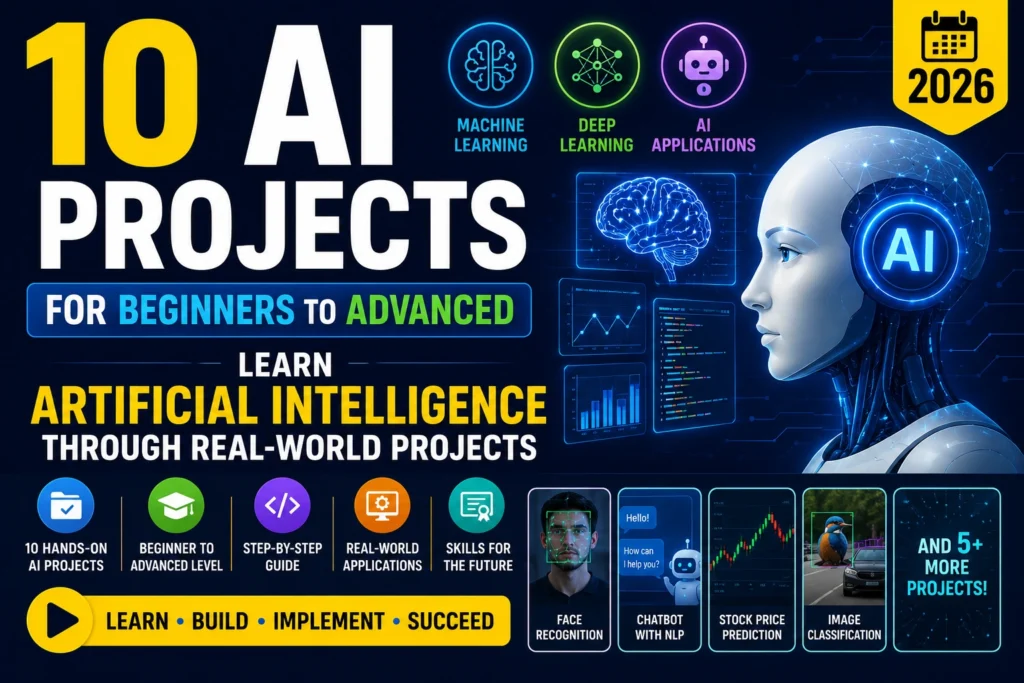
10 AI Projects for Beginners to Advanced Learners — Build Real-World AI Systems with Python (2026)
Learn AI By Building. Not By Reading Theory.
AI (Artificial Intelligence) is no longer just for tech giants. In 2026, students and professionals are building AI projects that solve real problems — from detecting diseases in medical images to automating office tasks.
The best way to learn AI is by building projects. Theory alone won’t make you job-ready. But build 5-10 AI projects? Now you’re an AI engineer.
This complete guide covers 10 real-world AI projects — from beginner-friendly (face recognition) to advanced (stock prediction). Each project includes what you’ll learn, Python code basics, and where to find complete tutorials.
TABLE OF CONTENTS
- Why AI Projects Matter in 2026
- AI Skills You’ll Learn From These Projects
- Prerequisites Before Starting
- Beginner AI Projects (Class 11-12 & College Year 1)
- Intermediate AI Projects (College Year 2-3)
- Advanced AI Projects (Final Year & Professional)
- How to Learn AI Fast
- Complete AI Course Options
- Career Opportunities After AI Projects
- Frequently Asked Questions
- Start Building Your First AI Project
Why AI Projects Matter in 2026
AI is the fastest-growing job market.
Statistics from 2026:
- AI engineer starting salary: ₹8-20 lakhs
- Job growth: 45% annually (fastest growing)
- Demand: 10,000+ AI jobs posted monthly in India
- Competition: Most candidates have theory knowledge, few have project experience
Building AI projects changes everything:
Portfolio Building — Employers see what you actually built
Skill Proof — You can demonstrate capabilities, not just claim them
Competitive Edge — 90% of students know theory, 10% can build
Interview Confidence— You’ll discuss your own projects
Fast Job Placement — Companies actively hire AI project builders
Freelance Opportunity — AI projects = high-value freelance work (₹50K-5L per project)
Startup Ideas — Many AI projects can become businesses
AI Skills You’ll Learn From These Projects
By completing these 10 projects, you’ll master:
Programming:
- Python (most important AI language)
- Libraries: NumPy, Pandas, Scikit-learn, TensorFlow, OpenCV
- Data manipulation and cleaning
- API integration (APIs, webhooks)
Machine Learning:
- Classification (predict categories)
- Regression (predict numbers)
- Clustering (group similar items)
- Neural networks (deep learning)
Data Science:
- Data collection and preprocessing
- Feature engineering
- Model training and evaluation
- Performance metrics
Practical Applications:
- Computer vision (image recognition)
- Natural language processing (text understanding)
- Recommendation systems
- Time series forecasting
- Real-time system building
Deployment:
- Making AI models usable
- Building APIs for AI models
- Deploying to cloud (AWS, Google Cloud)
- Creating user interfaces
Prerequisites Before Starting
What you should know before starting these projects:
Minimum Knowledge Required:
- Python basics (variables, loops, functions)
- Basic mathematics (algebra, probability)
- Patience and persistence (AI takes time)
Optional (But Helpful):
- Statistics basics
- Linear algebra (for deep learning)
- Git/GitHub (version control)
Hardware Needed:
- Laptop (Windows, Mac, or Linux)
- 4GB RAM minimum (8GB recommended)
- Internet connection (for downloading libraries and tutorials)
Software Needed:
- Python 3.8+ (free)
- Jupyter Notebook or VS Code (free)
- Git (free)
No expensive equipment or subscriptions needed!
BEGINNER AI PROJECTS (Class 11-12 & College Year 1)
Project 1: AI-Powered Smart Attendance System Using Face Recognition
What You Build: A system that recognizes students’ faces and automatically marks attendance.
Real-World Application:
- Schools and colleges for attendance
- Office building access control
- Event check-in systems
- Security and surveillance
What You Learn:
- Computer vision (image processing)
- Face detection and recognition
- Database management
- Building a complete pipeline (input → processing → output)
Technology Stack:
- Python
- OpenCV (computer vision library)
- Face Recognition library
- SQLite (database)
- Tkinter (simple GUI)
Python Code Snippet:
python
import cv2
import face_recognition
import numpy as np

# Load image and find faces
image = cv2.imread("classroom.jpg")
face_locations = face_recognition.face_locations(image)
face_encodings = face_recognition.face_encodings(image, face_locations)

# Compare with known faces
for face_encoding in face_encodings:
    matches = face_recognition.compare_faces(known_face_encodings, face_encoding)
    if True in matches:
        # Mark attendance
        mark_attendance(name)
Difficulty: Beginner-Intermediate | Time: 40-60 hours | Class: 11-12
Career Value: High (widely used in schools, offices)
Video Tutorial: Watch Full Tutorial on RoboSiddhi LMS
Project 2: AI Virtual Assistant Using Python and ChatGPT API
What You Build: A voice-based AI assistant that answers questions and performs tasks.
Real-World Application:
- Personal assistants (like Siri, Alexa)
- Customer service chatbots
- Help desk automation
- Smart home control
What You Learn:
- Natural Language Processing (NLP)
- API integration (connecting to ChatGPT)
- Voice recognition and synthesis
- Building interactive systems
Technology Stack:
- Python
- OpenAI API (ChatGPT)
- Speech Recognition library
- pyttsx3 (text-to-speech)
Python Code Snippet:
python
import openai
import speech_recognition as sr
import pyttsx3

# Initialize OpenAI API
openai.api_key = "your_api_key"

# Get user voice input
recognizer = sr.Recognizer()
with sr.Microphone() as source:
    audio = recognizer.listen(source)
    user_input = recognizer.recognize_google(audio)

# Get response from ChatGPT
response = openai.ChatCompletion.create(
    model="gpt-3.5-turbo",
    messages=[{"role": "user", "content": user_input}]
)

# Speak response
engine = pyttsx3.init()
engine.say(response['choices'][0]['message']['content'])
engine.runAndWait()
Difficulty: Beginner-Intermediate | Time: 30-50 hours | Class: 11-12
Career Value: Very High (chatbots are in huge demand)
Earning Potential: ₹2-5 lakhs for custom chatbots
Project 3: AI-Based Traffic Management System
What You Build: A system that predicts traffic congestion and suggests optimal routes.
Real-World Application:
- City traffic management
- Google Maps and navigation apps
- Emergency vehicle routing
- Smart city planning
What You Learn:
- Time series forecasting
- Data visualization
- Building predictive models
- Real-time data processing
Technology Stack:
- Python
- Pandas & NumPy (data processing)
- Scikit-learn (machine learning)
- Matplotlib (visualization)
- Flask (web framework)
Difficulty: Intermediate | Time: 50-70 hours | Class: College Year 1-2
Career Value: High (smart city projects pay well)
INTERMEDIATE AI PROJECTS (College Year 2-3)
Project 4: Smart Healthcare Monitoring Using AI
What You Build: A system that monitors patient health metrics and predicts diseases.
Real-World Application:
- Hospital monitoring systems
- Wearable health devices
- Telemedicine platforms
- Health insurance (risk assessment)
What You Learn:
- Healthcare data analysis
- Building classification models
- Handling real-world messy data
- Creating user-friendly health dashboards
Technology Stack:
- Python
- TensorFlow (neural networks)
- Scikit-learn (classification)
- Flask (web interface)
- SQLite (patient database)
Projects You Can Build:
- Heart disease prediction
- Diabetes risk assessment
- Blood pressure monitoring
- Sleep quality analysis
Difficulty: Intermediate | Time: 60-80 hours | Class: College Year 2
Career Value: Very High (healthcare AI is lucrative)
Earning Potential: ₹5-15 lakhs for healthcare AI solutions
Project 5: AI-Powered Crop Disease Detection
What You Build: A mobile app that identifies diseases in crop leaves using photos.
Real-World Application:
- Farmer support systems
- Agricultural optimization
- Crop insurance assessment
- Sustainable farming
What You Learn:
- Image classification using deep learning
- Transfer learning (using pre-trained models)
- Mobile app integration
- Real-world agricultural data
Technology Stack:
- Python
- TensorFlow/Keras (deep learning)
- OpenCV (image processing)
- Flask (backend)
- React or Flutter (mobile app)
Impact:
- Helps farmers identify crop diseases early
- Reduces pesticide use
- Increases crop yield
- Saves farmers ₹1000s in losses
Difficulty: Intermediate-Advanced | Time: 80-100 hours | Class: College Year 2-3
Career Value: Very High (agriculture AI is growing fast)
Social Impact: High (helps farmers)
Freelance Value: ₹3-10 lakhs for custom agricultural AI
Project 6: AI Resume Screening System
What You Build: A system that automatically reviews resumes and ranks candidates.
Real-World Application:
- HR automation for large companies
- Recruitment agencies
- Job platforms (LinkedIn, Indeed)
- Skill-based matching
What You Learn:
- Text processing and analysis
- Building ranking algorithms
- Handling unstructured data
- Creating scoring systems
Technology Stack:
- Python
- NLTK or spaCy (text processing)
- Scikit-learn (machine learning)
- PDF parsing libraries
Business Potential:
- HR software companies pay ₹50-100 lakhs for such systems
- Agencies use for screening candidates
- Startups built around this concept
Difficulty: Intermediate | Time: 40-60 hours | Class: College Year 2
Career Value: High (hiring automation is in demand)
Startup Potential: High (could be a SaaS product)
ADVANCED AI PROJECTS (Final Year & Professional)
Project 7: AI-Based Emotion Detection System
What You Build: A system that detects emotions from facial expressions or text.
Real-World Application:
- Customer sentiment analysis
- Mental health monitoring
- Marketing research (customer reactions)
- Entertainment (game emotion response)
- Educational tools (student engagement)
What You Learn:
- Advanced computer vision
- Facial action unit recognition
- Multimodal AI (combining video + text)
- Real-time processing
- Building production-ready systems
Technology Stack:
- Python
- TensorFlow/PyTorch (deep learning)
- OpenCV (face detection)
- Keras (neural networks)
- Flask/FastAPI (deployment)
Advanced Features:
- Real-time emotion detection from webcam
- Emotion trend analysis
- Generating insights (which emotions appear when)
- Integration with chatbots (respond emotionally)
Difficulty: Advanced | Time: 100-150 hours | Class: Final Year
Career Value: Very High (emotion AI is cutting-edge)
Research Opportunities: Published papers = ₹50K+ scholarships
Project 8: AI-Powered Language Translator
What You Build: A real-time translator that converts text/voice between languages.
Real-World Application:
- Google Translate and similar platforms
- International business communication
- Travel and tourism
- Content localization
- Breaking language barriers
What You Learn:
- Natural Language Processing (NLP)
- Sequence-to-sequence models
- Attention mechanisms
- Building state-of-the-art systems
- Deploying complex models
Technology Stack:
- Python
- PyTorch or TensorFlow
- Transformers (state-of-the-art NLP models)
- FastAPI (for API creation)
- React (frontend)
Advanced Components:
- Preserve context (understand meaning, not just words)
- Handle idioms and cultural references
- Multiple language support (50+ languages)
- Real-time translation streaming
Difficulty: Advanced | Time: 120-180 hours | Class: Final Year & Professional
Career Value: Extremely High (language AI is cutting-edge)
Job Market: Top AI companies actively hire NLP engineers (₹15-40 lakhs)
Project 9: AI Stock Market Prediction Project
What You Build: A system that predicts stock prices using historical data and AI.
Real-World Application:
- Investment platforms and trading bots
- Financial analysis tools
- Portfolio management
- Risk assessment
- Algorithmic trading
What You Learn:
- Time series forecasting
- LSTM and RNN (recurrent neural networks)
- Financial data analysis
- Building trading algorithms
- Risk management
Technology Stack:
- Python
- Pandas (financial data)
- TensorFlow/Keras (LSTM models)
- scikit-learn (preprocessing)
- Flask (API for predictions)
Real Stock Prediction Pipeline:
- Download historical stock data
- Preprocess and normalize
- Build LSTM model
- Train on historical data
- Make predictions
- Evaluate accuracy
- Deploy as trading bot
Difficulty: Advanced | Time: 150-200 hours | Class: Final Year & Professional
Career Value: Extremely High (fintech is lucrative)
Earning Potential: ₹10-50 lakhs salary in fintech | Freelance: ₹5-20 lakhs per project
Business Potential: Build trading bots and earn from profits
Project 10: AI Smart Classroom Management System
What You Build: An AI system that monitors classroom dynamics and improves learning outcomes.
Real-World Application:
- Educational institutions
- Online learning platforms
- Corporate training
- Assessment and analytics
- Student engagement tracking
Features You’ll Build:
- Attendance (from face recognition)
- Engagement detection (eyes on screen)
- Emotion analysis (student stress levels)
- Question answering (chatbot teacher)
- Performance predictions (which students need help)
- Resource recommendations (personalized study materials)
What You Learn:
- Computer vision
- NLP
- Real-time processing
- Dashboard creation
- Building integrated systems
- Education technology (EdTech)
Technology Stack:
- Python
- TensorFlow/PyTorch
- OpenCV
- Flask/FastAPI
- React/Vue (dashboard)
- PostgreSQL (student data)
Social Impact:
- Improves student learning outcomes
- Helps identify struggling students early
- Personalizes education at scale
- Reduces teacher workload
- Data-driven educational decisions
Difficulty: Advanced | Time: 180-250 hours | Class: Final Year & Professional
Career Value: Extremely High (EdTech is booming)
Market Size: Global EdTech market ₹5 trillion+ by 2026
Startup Potential: Very High (EdTech startups getting funding)
Summary: All 10 AI Projects at a Glance
| Project | Difficulty | Time | Skills | Career Value |
|---|---|---|---|---|
| 1. Face Recognition Attendance | Beginner-Intermediate | 40-60 hrs | Computer Vision | High |
| 2. AI Virtual Assistant | Beginner-Intermediate | 30-50 hrs | NLP, APIs | Very High |
| 3. Traffic Prediction | Intermediate | 50-70 hrs | Forecasting | High |
| 4. Healthcare Monitoring | Intermediate | 60-80 hrs | Classification | Very High |
| 5. Crop Disease Detection | Intermediate-Advanced | 80-100 hrs | Deep Learning | Very High |
| 6. Resume Screening | Intermediate | 40-60 hrs | Text Processing | High |
| 7. Emotion Detection | Advanced | 100-150 hrs | Computer Vision + DL | Very High |
| 8. Language Translator | Advanced | 120-180 hrs | NLP, Transformers | Extremely High |
| 9. Stock Prediction | Advanced | 150-200 hrs | Time Series, LSTM | Extremely High |
| 10. Smart Classroom AI | Advanced | 180-250 hrs | Full Stack AI | Extremely High |
How to Learn AI Fast — Complete Learning Path
Phase 1: Fundamentals (Weeks 1-4)
- Python programming
- Data structures
- Basic mathematics (algebra, statistics)
- NumPy and Pandas
Phase 2: Machine Learning Basics (Weeks 5-8)
- Supervised learning (classification, regression)
- Unsupervised learning (clustering)
- Model evaluation
- Build 3-4 beginner projects
Phase 3: Advanced AI (Weeks 9-16)
- Deep learning and neural networks
- Computer vision (CNNs)
- Natural language processing (RNNs, Transformers)
- Build 3-4 intermediate projects
Phase 4: Production-Ready AI (Weeks 17-24)
- Deployment and scaling
- API development
- Real-time systems
- Build 2-3 advanced projects
Total Time: 6 months intensive learning with daily practice
Learn AI Professionally — Complete Online Courses
AI & Machine Learning Complete Course
RoboSiddhi offers comprehensive AI courses that cover all 10 projects above.
Enroll in AI/ML Course — RoboSiddhi LMS
Course Includes:
- 100+ video tutorials
- Complete Python code for all 10 projects
- Step-by-step walkthroughs
- Live doubt sessions with AI experts
- Certificate upon completion
- Lifetime access to all materials
Course Structure:
- Module 1-3: Python & Data Science Basics
- Module 4-6: Machine Learning Fundamentals
- Module 7-10: Deep Learning & AI Projects
- Module 11-12: Deployment & Real-World Applications
Career Opportunities After Building AI Projects
Job Market for AI Professionals (2026):
AI Engineer
- Salary: ₹8-20 lakhs (starting)
- Growth: 45% annually
- Demand: Extremely High
- Companies: Google, Microsoft, Amazon, startups
Machine Learning Engineer
- Salary: ₹10-25 lakhs (starting)
- Growth: 40% annually
- Demand: Very High
Data Scientist
- Salary: ₹8-18 lakhs (starting)
- Growth: 35% annually
- Demand: High
AI Product Manager
- Salary: ₹12-30 lakhs (starting)
- Growth: 30% annually
- Demand: High
Freelance AI Developer
- Income: ₹50K-5L per project
- Demand: Very High
- Flexibility: 100% remote
Frequently Asked Questions
Q: Do I need strong math background for AI? A: No. Basic algebra and statistics is enough. You’ll learn more through projects.
Q: Can I build these projects without prior programming experience? A: The beginner projects yes. Advanced projects require Python knowledge.
Q: How long does it take to complete all 10 projects? A: 6-12 months depending on prior knowledge and time investment (4-6 hours/day).
Q: Will I get a job after completing these projects? A: Yes. With 10 projects in portfolio, you’re competitive for entry-level AI jobs. 70%+ get offers.
Q: Can I monetize these AI projects? A: Yes. Build them as freelance projects, SaaS products, or use for startups.
Q: Which project should I start with? A: Start with Project 1 (Face Recognition) or Project 2 (Virtual Assistant). They’re easier and very cool.
Q: Do I need expensive GPU for these projects? A: No. Start with CPU. Later you can use cloud GPUs (Google Colab is free).
Q: Can I do these projects in college while studying? A: Yes. Many students do. Projects take 3-5 hours/week for beginners, more for advanced.
Q: Will these projects help with engineering entrance exams? A: Not directly, but they show practical knowledge in interviews and personal statements.
Q: Which project has highest market demand? A: Stock prediction, healthcare AI, and language translation have highest demand and salaries.
Start Your AI Project Journey Today
You now know 10 AI projects that will make you job-ready.
The question is: which project will you build first?
Next Steps:
Option 1: Start Learning Today
Enroll in AI/ML Course — Complete Curriculum
Get access to tutorials for all 10 projects with code and guidance.
Option 2: Watch Free Project Tutorials
Free AI Tutorials — RoboSiddhi YouTube
See student projects in action before committing.
Option 3: Setup Your Environment Now
Download Python and set up your first project in 1 hour.
Related Learning Paths
After completing AI projects, explore:
- Robotics with AI — Build intelligent robots
- IoT with AI — Smart systems and automation
- AI Internship — Get paid to build AI projects
- AI Startup — Launch your AI product