
Introduction
Have you ever wondered how a remote-controlled car moves, how a television displays pictures, or how a fan starts spinning with the press of a button?
The answer lies in electronics. Think of electronics as a secret language that tells machines what to do. It uses electricity and tiny components working together to make gadgets function.
If you’re curious about how technology works, this guide on basic electronic components for beginners will help you understand the building blocks of electronics in a simple and fun way.
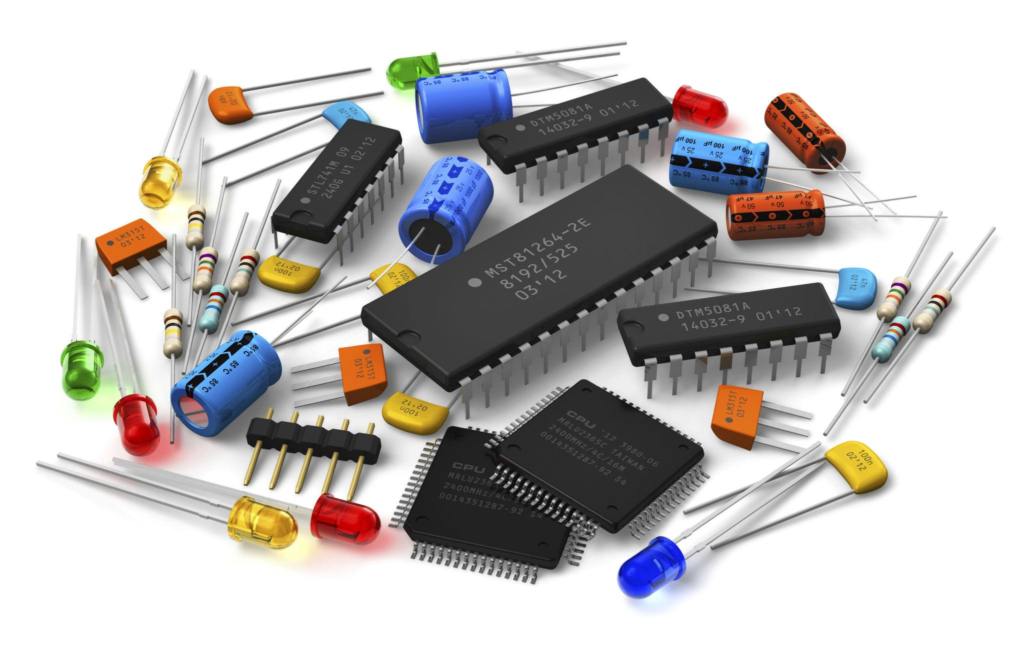
Table of Contents
What is Electronics?
Electronics is the science of using electricity to make devices perform useful tasks.
From smartphones and computers to toys and household appliances, electronics is everywhere. It allows electricity to flow through circuits and perform actions such as producing light, sound, movement, and communication.
Without Basic Electronic Components for Beginners many of the devices we use every day would not exist.
Electronics Around Us
Examples of electronic devices include:
- Television
- Remote-controlled cars
- Mobile phones
- Fans
- Coolers
- Computers
- Toys
These devices contain different electronic components that work together to perform specific functions.
Understanding Electricity Flow
A simple way to understand electricity is to compare it with water flowing through pipes.
Imagine:
- Water travels through pipes to reach a tap.
- Electricity travels through wires to reach a device.
Just as water powers household activities, electricity powers electronic gadgets.
This analogy makes it easier for beginners to understand how current flows inside a circuit.
Why Should Students Learn Basic Electronic Components for Beginners
Learning Basic Electronic Components for Beginners is exciting because it helps you understand how technology works.
Benefits of Learning Electronics
- Understand how gadgets operate
- Develop problem-solving skills
- Improve creativity
- Build your own projects
- Learn robotics and automation
- Prepare for future STEM careers
Electronics encourages students to think like inventors and engineers.
What Are Basic Electronic Components for Beginners
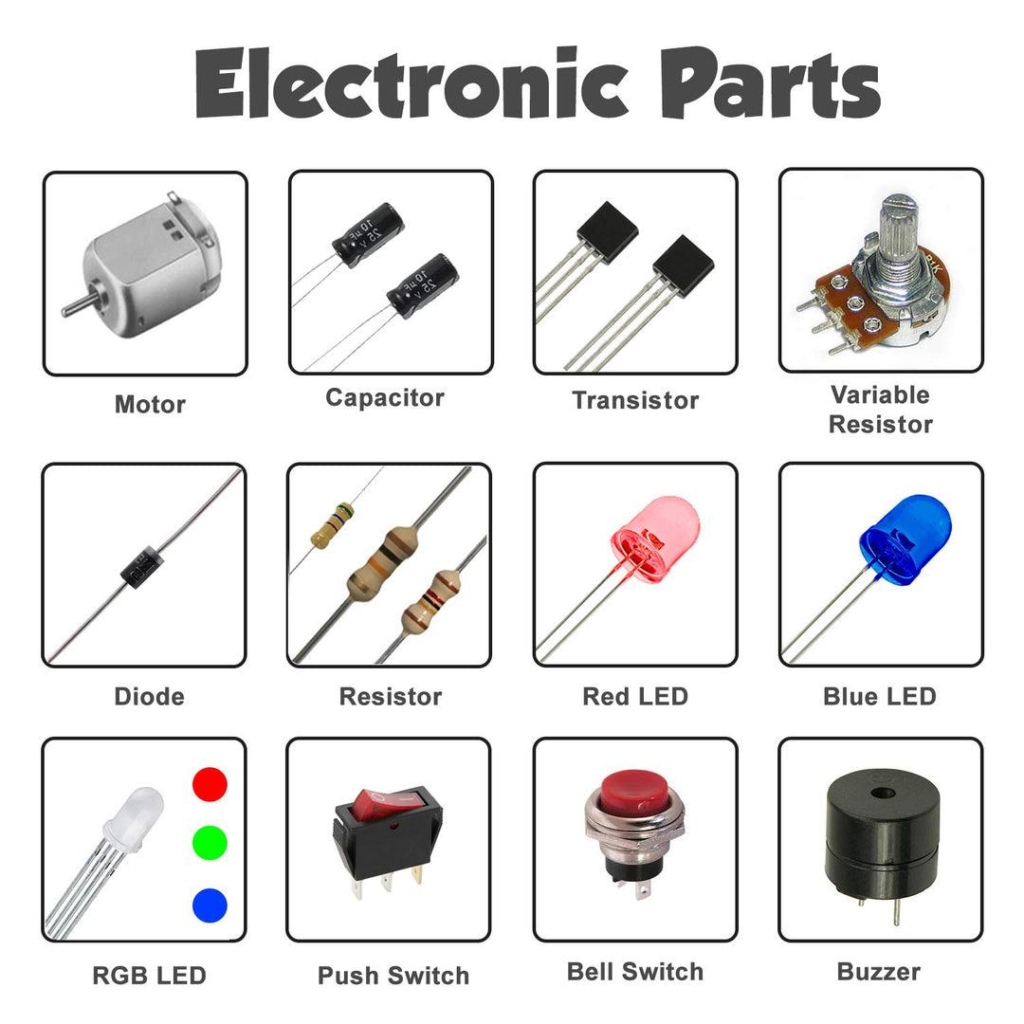
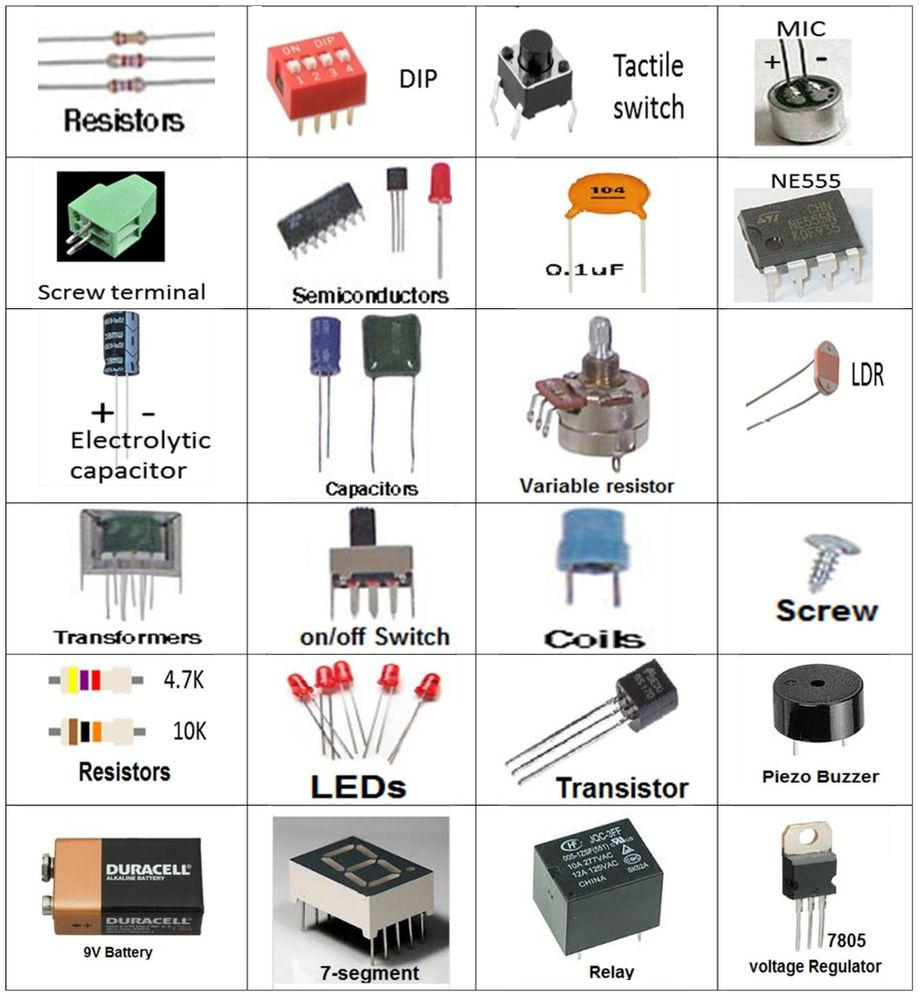
Basic Electronic Components for Beginners are the individual parts that make up an electronic circuit.
You can think of them like LEGO blocks.
Each block has a different purpose, but when combined together, they create something amazing.
Similarly, electronic components work together to build devices such as robots, computers, and smart gadgets.
Basic Electronic Components for Beginners
The following components are commonly used in beginner electronics projects.
| Component | Function / Description | Analogy |
|---|---|---|
| Battery | Provides electrical power | Fuel for a car |
| LED | Produces light when electricity flows through it | Small glowing light in toys |
| Buzzer | Produces sound alerts | Sound maker |
| Resistor | Controls and reduces current flow | Speed bump slowing current |
Battery
A battery is the power source of a circuit.
Just like a car needs fuel to run, electronic devices need a battery to supply electricity.
LED (Light Emitting Diode)
An LED produces light when electricity passes through it.
LEDs are used in toys, indicators, displays, and decorative lighting.
Buzzer
A buzzer creates sound when electricity flows through it.
You can hear buzzers in alarms, microwaves, and electronic notification systems.
Resistor
A resistor controls the amount of current flowing through a circuit.
It acts like a speed bump on a road, slowing down electrical flow and protecting sensitive components.
Understanding Circuit Symbols
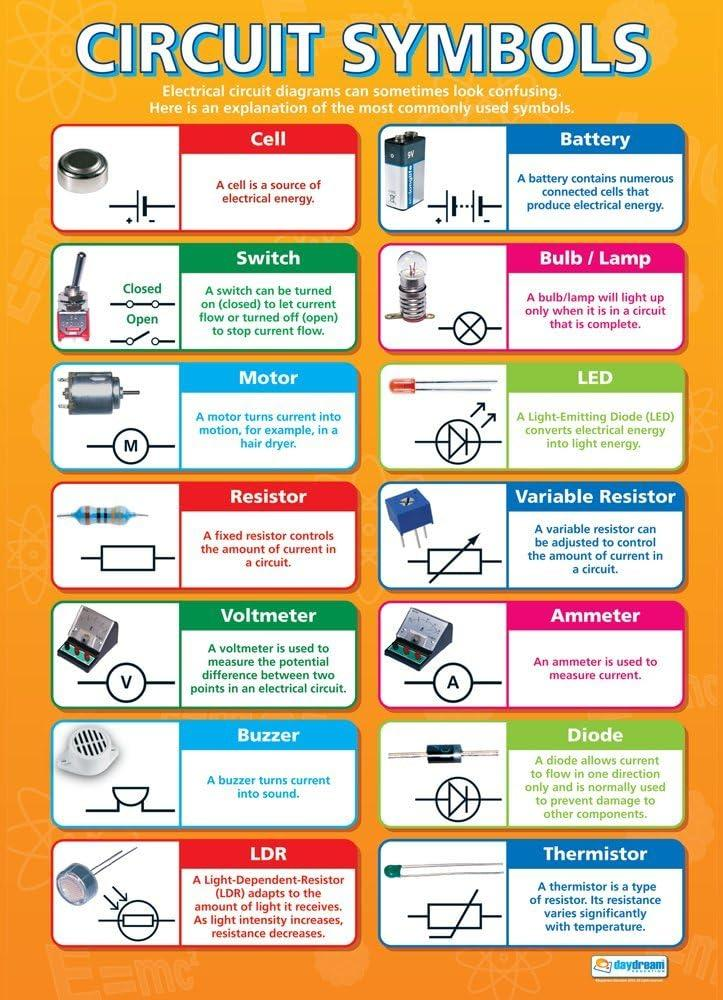
Engineers use special symbols instead of drawing actual components in circuit diagrams.
These symbols act as a universal language for electronics.
Common Circuit Symbols
| Component | Symbol Description |
|---|---|
| Battery | Two parallel lines, one longer and one shorter |
| LED | Triangle with a line and arrows pointing outward |
| Resistor | Zigzag line |
Learning these circuit symbols helps students read and create electronic circuit diagrams.
Why Circuit Symbols Are Important
Circuit symbols make diagrams:
- Easier to read
- Faster to draw
- Universally understood
- Useful for troubleshooting
Every electronics engineer learns symbols before building complex circuits.
Electronics Safety for Kids
Safety should always be the first priority when working with electronics.
Safety Rule 1: Never touch electronic components with wet hands. Water and electricity are dangerous together.
Safety Rule 2: Always ask an adult before using tools or building electronic projects.
Safety Rule 3: Never open electronic devices without permission or supervision.
Treat electronic devices carefully and responsibly at all times.
How Electronic Components Work Together
A single electronic component cannot do much on its own.
For example:
- The battery provides power.
- The resistor controls the current.
- The LED produces light.
- The buzzer creates sound.
When these components are connected together in a circuit, they can create useful electronic projects.
This teamwork between components is what makes electronics so powerful.
Real-Life Applications of Basic Electronic Components for Beginners
Electronics is used in almost every modern technology.
Examples include:
- Home appliances
- Mobile phones
- Computers
- Smart devices
- Robots
- Security systems
- Medical equipment
- Automobiles
Understanding the basics opens the door to creating your own inventions in the future.
Homework and Next Steps
Ready to test your knowledge?
Activity 1
Find five electronic items in your home.
Examples:
- TV
- Fan
- Remote control
- Mobile phone
- Toy car
Activity 2
Choose one item and draw it.
Try to guess which electronic components might be inside.
What’s Next?
In the next lesson, explore the resistor, often called the traffic cop of electricity, because it controls the flow of current inside a circuit.
Watch the Video Tutorial
Want to learn about electronics in a fun and easy way? Watch our complete video tutorial where we explain what electronics is, how electronic components work, circuit symbols, safety rules, and beginner-friendly examples.
In this video, you will learn:
- What is electronics?
- How electricity flows in a circuit
- Basic electronic components and their functions
- Electronic symbols used in circuit diagrams
- Electronics safety rules for kids
- Why learning electronics is important
This tutorial is perfect for beginners, students, parents, and anyone starting their STEM learning journey.
Why Learn Electronics with RoboSiddhi?
RoboSiddhi makes learning electronics fun, practical, and beginner-friendly. Instead of only reading theory, students build real projects and understand how technology works in everyday life.
What Makes RoboSiddhi Different?
- Hands-on STEM LearningStudents learn by doing — building circuits, testing components, and creating working electronic projects.
- Beginner-Friendly ProjectsProjects are designed for school students and beginners, making electronics easy to understand step by step.
- Real-World SkillsLearners develop problem-solving, creativity, coding, robotics, and engineering skills that are useful for future careers.
- Innovation and CreativityFrom simple LED circuits to smart devices and robots, students are encouraged to invent and experiment with their own ideas.
- Future Technology ExposureRoboSiddhi introduces students to robotics, AI, IoT, and automation, helping them gain early exposure to modern technology.
Explore More with RoboSiddhi
- Electronics kits and components
- Arduino and robotics projects
- Coding workshops for students
- STEM activities for schools
- Creative DIY technology projects
Start Your Electronics Journey Today
Whether you are a student, parent, or teacher, RoboSiddhi helps make electronics learning exciting and accessible. Build, explore, and create the technology of tomorrow — one component at a time.
Conclusion
Learning about basic electronic components for beginners is the first step toward understanding the technology that powers our everyday lives.
By learning about batteries, LEDs, buzzers, resistors, circuit symbols, and safety rules, students can build a strong foundation in electronics and STEM education.
The more you explore electronics, the more exciting inventions you will be able to create in the future.