
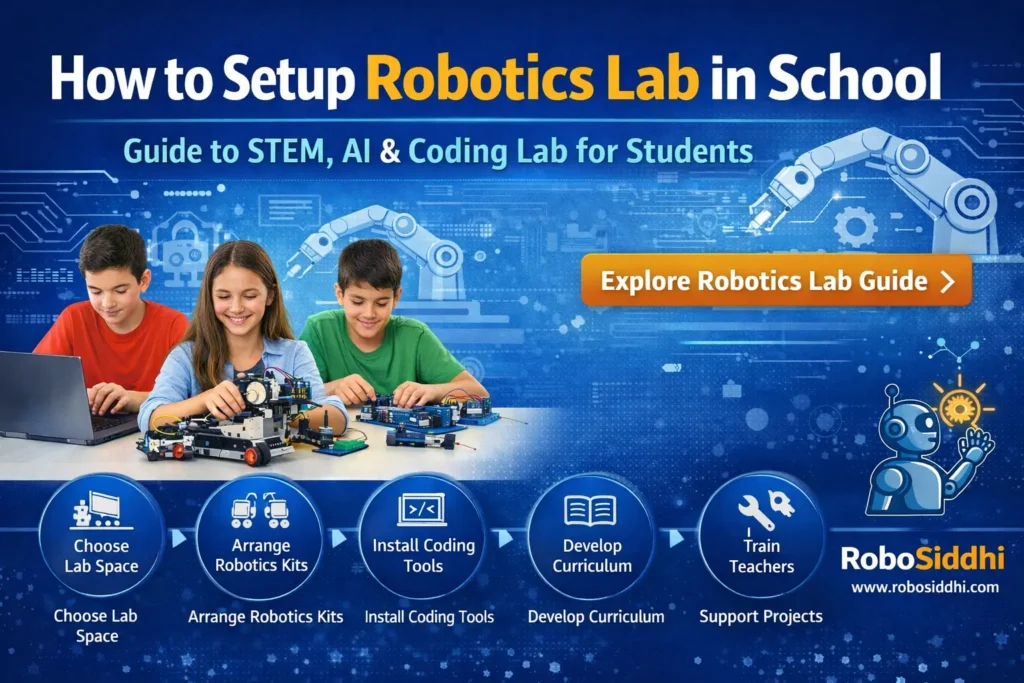
If you are wondering how to setup robotics lab in school, the process involves planning the lab infrastructure, arranging robotics kits, installing coding tools, and implementing a structured robotics curriculum.
A well-designed Robotics Lab Setup in School helps students learn STEM education, coding, artificial intelligence (AI), and IoT technologies through practical projects and hands-on experiments.
To explore the complete robotics lab guide, visit our detailed article:
https://robosiddhi.com/robotics-lab-setup-in-school/
1. Choose a Dedicated Lab Space
The first step in how to setup robotics lab is selecting a suitable classroom space where students can work comfortably on robotics projects.
Recommended requirements:
• 600–1000 sq ft classroom space
• Good lighting and ventilation
• High-speed internet connection
• 6–8 working tables for students
• Storage cabinets for robotics kits
A robotics lab should comfortably support 20–30 students per batch.
2. Arrange Robotics Kits and Hardware
The next step in how to setup robotics lab in school is arranging the required robotics kits and electronic components.
Essential equipment includes:
• 100+ educational robotics kits
• Arduino or microcontroller boards
• Breadboards and jumper wires
• Motors and motor drivers
• Ultrasonic, IR, and other sensors
• Wheels, chassis, and mechanical parts
• Battery packs and power modules
These components allow students to build real robotics systems and automation projects.
3. Install Coding and Programming Tools
Coding software is required for programming robots and developing smart systems.
Common tools used in robotics labs include:
• Block-based coding platforms
• Arduino IDE
• Python programming basics
• AI and IoT learning platforms
These platforms help students understand coding logic and automation systems.
4. Create a Structured Robotics Curriculum
A proper curriculum is important in how to setup robotics lab for students.
Example class-wise structure:
Class 1–3
• Basic machines and simple robotics models
Class 4–6
• Robotics basics and block coding
Class 7–8
• Arduino programming and sensors
Class 9–10
• IoT, AI, and advanced robotics projects
5. Provide Teacher Training and Lab Support
Teachers need proper training to guide students in robotics learning.
Important support systems include:
• Teacher training programs
• Monthly instructor visits
• Robotics competitions and exhibitions
• Project-based learning activities
6. Encourage Robotics Projects
Hands-on projects are essential when implementing how to setup robotics lab in schools.
Popular projects include:
• Line follower robot
• Obstacle avoiding robot
• Smart home automation system
• IoT-based monitoring systems
Conclusion
Understanding how to setup robotics lab helps schools introduce future technologies like robotics, AI, and coding in a practical way. A well-equipped robotics lab creates an engaging learning environment where students develop creativity, innovation, and problem-solving skills.
Robotics education prepares students for the future and supports modern STEM learning in schools.
Robosiddhi Private Limited
www.robosiddhi.com