
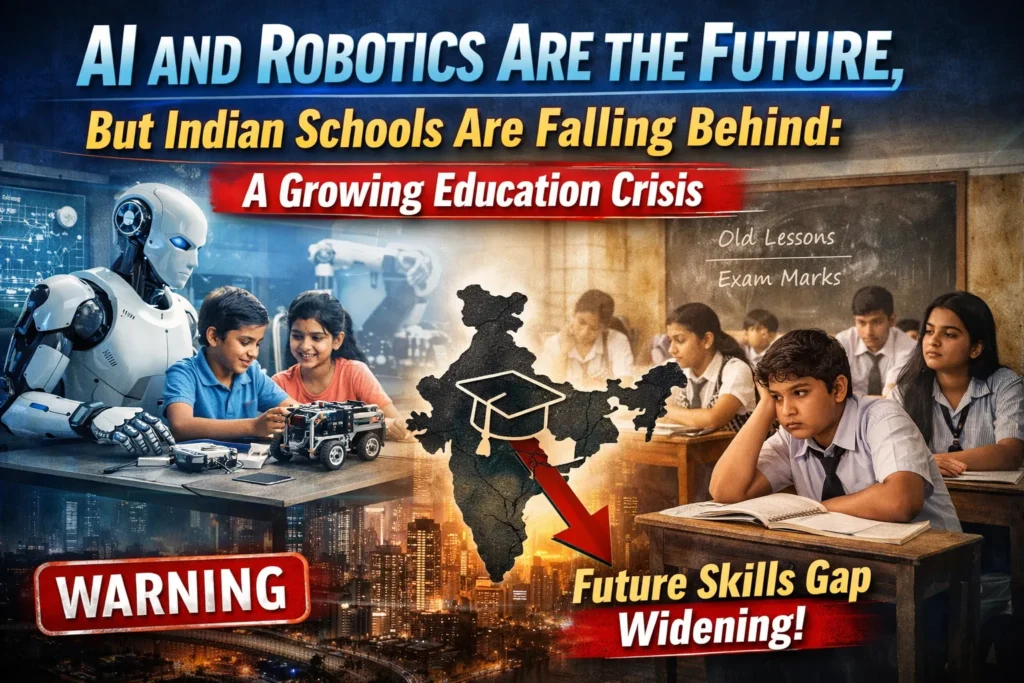
AI and Robotics are the future, yet a large number of Indian schools are still operating with outdated, theory-driven education systems.
While industries are rapidly shifting toward automation, artificial intelligence, and robotics, classroom learning in many schools remains limited to textbooks, exams, and memorization. This growing disconnect is creating a serious future skills gap among students.
The Core Issue: Education Has Not Kept Pace
Across India today:
- Students score marks but lack practical problem-solving skills
- AI, robotics, and STEM exposure is minimal or absent
- Technology is discussed in theory but rarely experienced hands-on
Education experts warn that if AI and Robotics are the future, then students must be exposed to these technologies before they enter higher education.
What Needs to Change
To bridge this gap, schools must:
- Move from rote learning to hands-on, experiential learning
- Introduce STEM, Robotics, and AI concepts at the school level
- Focus on skills such as logical thinking, creativity, and innovation
- Align learning with future industry requirements and NEP 2020 goals
Without this shift, students risk falling behind global education standards.
What RoboSiddhi Is Doing Differently
Recognizing that AI and Robotics are the future, RoboSiddhi is working closely with schools to transform learning at the grassroots level.
RoboSiddhi focuses on:
- Introducing practical STEM and Robotics learning from early classes
- Helping schools move beyond theory with project-based education
- Supporting teachers with structured, easy-to-implement lab models
- Creating learning environments where students build, test, and learn
Instead of treating robotics as a one-time activity, RoboSiddhi promotes it as a regular learning tool that builds confidence and real-world skills.
Why Early Action Matters
Schools that adopt hands-on STEM and robotics learning early are seeing:
- Higher student engagement
- Better conceptual understanding
- Improved readiness for future careers
The goal is no longer just academic performance, but future readiness.
The Bottom Line
AI and Robotics are the future.
Education systems that fail to evolve risk leaving students unprepared for tomorrow’s world.
The real question is not whether schools should change —
but how quickly they act.
FAQs
Why are AI and Robotics important for Indian students?
Because future jobs will demand technology awareness, problem-solving skills, and hands-on experience with AI and automation.
Can schools introduce robotics without advanced infrastructure?
Yes. With structured STEM and robotics programs, schools can start step by step without complex setups.
How does RoboSiddhi support schools in this transition?
RoboSiddhi helps schools implement practical STEM and robotics learning through curriculum support, lab planning, and hands-on project models.
Is this approach aligned with NEP 2020?
Yes. NEP 2020 strongly encourages experiential, skill-based, and technology-driven education.